


Lab-Grown Diamonds Canada: The Complete 2026 Guide

Editorial standard: Carat Theory editorial policy. Co-Founder: Sahil Meghani.
The complete guide
Lab-grown diamonds are real diamonds - chemically, physically, and optically identical to mined ones, grown in a controlled lab environment instead of underground. In Canada, buyers compare lab-grown diamonds for IGI certification, transparent sourcing, 14K gold settings, and pricing that is not built around mined scarcity.
What lab-grown diamonds actually are
Lab-grown diamonds are real diamonds. Not a simulant, not a substitute - the same carbon crystal structure, the same hardness (10 on the Mohs scale), and the same basic optical properties as mined diamond.
The difference is origin. A mined diamond forms over geological time under extreme pressure deep in the earth. A lab-grown diamond forms in a controlled growth environment. A standard diamond tester cannot tell them apart; origin disclosure comes from laboratory analysis and the certificate language.
How they're actually made
Two main methods produce gem-quality lab-grown diamonds. Both produce real diamonds and can reach the highest colour and clarity grades.
Chemical vapour deposition (CVD)
The most widely used method. A thin diamond seed sits inside a sealed chamber filled with a carbon-rich gas, ionized into plasma above 900 °C. Carbon atoms deposit layer by layer over several weeks. The precise control over the growth environment is why CVD consistently reaches high colour and clarity grades, up to D/VVS1.
High pressure, high temperature (HPHT)
HPHT reproduces deep geological conditions: a diamond seed is subjected to over 1.5 million PSI and temperatures above 1,400 °C alongside a carbon source, usually graphite. An IGI certificate always states which growth method was used.
Price: what the gap actually looks like in Canada
Lab-grown diamonds often cost materially less than mined diamonds of comparable weight. Here is a real, verified comparison for ~1.00 ct round brilliant diamond stud earring pairs, priced directly on each retailer's own site.
| Retailer | Type | Price (CAD) |
|---|---|---|
| Birks | Mined diamond | $7,200 |
| Michael Hill | Mined diamond | $5,499 |
| Brilliant Earth Canada | Mined diamond | $2,830 |
| Carat Theory | Lab-grown diamond, IGI certified | $740 |
Verified live: Birks' 1.00 ct round 3-prong stud (H colour, SI1 clarity, 18K white gold); Michael Hill's 1.00 ct TW round solitaire stud (HI colour, I2 clarity, 18K white gold); Brilliant Earth's 1.00 ct TW 4-prong stud (18K white gold, colour and clarity not disclosed on the evaluated page). Carat Theory's is the Lumière Stud 1 CT (E-F colour, VVS2 clarity, 14K gold) - the same product priced and sourced in our Price Bridge comparison of seven Canadian retailers. Metal karat and exact grade vary by retailer - compare specifications, not just price, before drawing a conclusion.
The diamond itself is chemically and physically identical whether mined or lab-grown. The price gap reflects mining premiums, supply-chain margins, and brand legacy - not a lesser stone. For why lab-grown diamonds cost less in general, read our explanation. For broader pricing context, compare what a diamond costs in Canada and our lab-grown diamond price index.
One honest note: lab-grown prices have already dropped significantly and may continue to drop. If you are buying a lab-grown diamond as a financial asset, it is not one. Buy it because it is a beautiful stone at a price that makes sense to you.
Understanding the 4Cs
Cut
The most important of the four Cs, and the most misunderstood. It is not the shape (round, oval, cushion) but how precisely the facets are proportioned. An Excellent cut maximizes brilliance, fire, and scintillation. Always prioritize Excellent or Very Good.
Colour
Graded D (perfectly colourless) to Z. For a white stone, G or H colour is the sweet spot: white to the eye in every lighting condition, with a real price advantage over D-F stones.
Clarity
Measures internal inclusions, from Flawless down to I1-I3. A VS2 or SI1 stone is usually "eye-clean" - no inclusion visible without magnification - for excellent value.
Carat
The unit of weight (1ct = 0.2g). Prioritize cut quality first, then the highest carat weight your budget allows.
IGI certification: what to look for
The large majority of lab-grown diamonds sold in Canada carry an IGI (International Gemological Institute) certificate - the largest independent gemological lab in the world, with facilities in Antwerp, New York, Mumbai, and elsewhere. Every IGI-certified diamond also gets a permanent laser inscription on the girdle - invisible to the naked eye, readable under magnification - that you can verify at any time at verify.igi.org.
Never buy a stone without a verifiable IGI certificate.
Lab-grown diamonds and sustainability
Lab-grown diamonds avoid diamond mining and the land disturbance associated with extraction. They still require energy to grow, cut, polish, ship, and set, so the environmental picture depends on the producer, power source, and supply chain. The cleaner claim is not that lab-grown is impact-free; it is that origin can be disclosed without mining the stone.
How to buy in Canada
- Always require an IGI certificate - it is your only independent proof of quality.
- Check the laser inscription on the girdle against the certificate number.
- Compare equivalent specs - same carat, colour, clarity, and cut grade.
- Confirm the gold karat (10K, 14K, 18K) on the setting is clearly stated and verifiable.
At Carat Theory, every diamond over 0.50 carat includes its own independent IGI certificate, and smaller accent diamonds are certified by IGI together at the jewellery level. If you are comparing finished jewellery, start with lab-grown diamond earrings, diamond necklaces, diamond bracelets, or use the ring builder to pair a stone with a custom setting.
 IGI documented, transparent pricingIndividual IGI certificates for diamonds over 0.50 carat; jewellery-level IGI certification for smaller accents.The Sovereign Stud$1,040.00
View →
IGI documented, transparent pricingIndividual IGI certificates for diamonds over 0.50 carat; jewellery-level IGI certification for smaller accents.The Sovereign Stud$1,040.00
View →
Frequently asked
Are lab-grown diamonds real diamonds?
Yes. They are chemically and physically identical to mined diamonds, and the US FTC dropped "natural" from its legal definition of a diamond in 2018 specifically because lab-grown stones meet every test of one. The only difference is how they were formed.
Can you tell a lab-grown diamond from a mined one?
Not visually, and no standard diamond tester can either. Only specialized spectroscopy equipment can identify growth patterns.
How much do lab-grown diamonds cost in Canada?
Often materially less than a comparable mined diamond, though the exact gap varies by carat weight, cut, colour, clarity, certification, retailer, and date. See our Price Index for real, dated comparisons across Canadian retailers.
Do lab-grown diamonds hold their value?
Do not buy lab-grown diamond jewellery as a financial investment. Resale outcomes vary and are usually below retail purchase price.
What certification should I look for?
IGI. Diamonds above 0.50 carat include their own individual IGI certificate. Diamonds below 0.50 carat are certified at the jewellery level.
Do lab-grown diamonds get cloudy over time?
No. What dulls any diamond is a film of hand cream, soap, and skin oil underneath the stone. Warm water, a drop of dish soap, and a soft toothbrush restores it.

You might also like
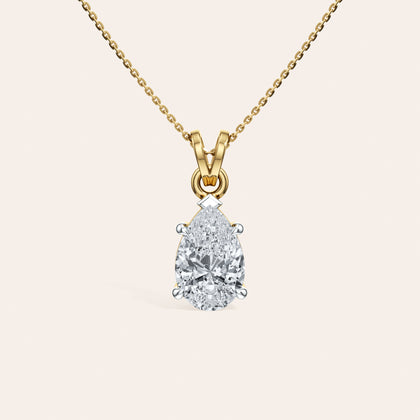
The Lumina Pendant
2.07 CT. T.W.PEAR$2,100.00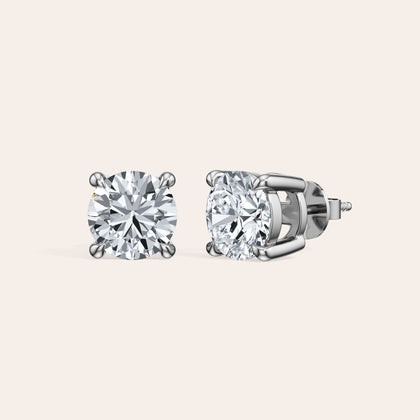
The Lumière Stud 1.5 CT
1.48 CT. T.W.ROUND BRILLIANT$1,080.00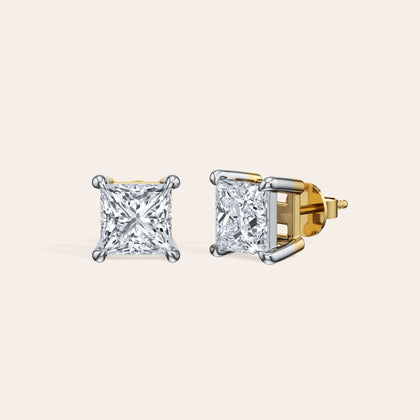
The Crest Stud
1.20 CT. T.W.PRINCESS$1,010.00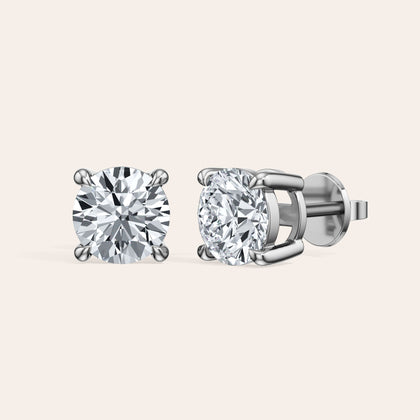
The Lumière Stud 2 CT
2.02 CT. T.W.ROUND BRILLIANT$1,400.00Complimentary shipping and free 14-day returns - decide with total peace of mind, at no cost.