


Lab-Grown Diamonds vs Moissanite: What's Actually Different

Editorial standard: Carat Theory editorial policy. Co-Founder: Sahil Meghani.
Comparison
In a photo, a lab-grown diamond and a moissanite are near-twins. In person, under real light, each one eventually tells on itself. Here is the honest version - without the sales pitch.
Start with a true story. Moissanite was not invented in a lab to copy diamonds. It was first found in 1893 by the chemist Henri Moissan, inside a meteorite crater in Arizona. He thought he had found diamonds. He had found something else: silicon carbide, a stone from space, so rare on Earth that today we grow it in a lab.
What each stone actually is
A diamond - mined or lab-grown - is pure carbon. A lab-grown diamond is a real diamond, with the same structure and the same optics; only its origin differs. A moissanite is a different stone (silicon carbide) that resembles a diamond. It is not a fake diamond. It is a beautiful stone in its own right - one that plays by its own optical rules.
| Lab-grown diamond | Moissanite | |
|---|---|---|
| What it is | Pure carbon (a real diamond) | Silicon carbide |
| Hardness (Mohs) | 10 (the maximum) | 9.25 (very hard) |
| Sparkle (fire) | Balanced, white | More intense, rainbow |
| Price ~1 ct | ~$800-2,000 | ~$300-600 |
| For daily wear | Scratch-proof, timeless | Very durable, livelier flash |
How to spot the difference in real life
The difference is not on the label - it shows up in motion. Moissanite throws more fire: under a ceiling light or in sun, it flashes strong rainbow colours. On a smaller stone, that looks gorgeous. On a large one, some people find it a touch "disco ball." A diamond keeps a whiter, calmer sparkle. Neither is better in the absolute - it is a matter of taste.
We only sell lab-grown diamonds. That does not require us to pretend moissanite is nothing. It is a beautiful stone - just a different one.
Who each stone is actually for
Moissanite makes sense if
- Budget is the number-one priority.
- You love a bright, colourful flash.
- It is a travel, everyday, or stand-in ring.
- Maximum size matters more than the stone type.
A lab-grown diamond makes sense if
- You want a real diamond without the mined price.
- You prefer a white, quiet, timeless sparkle.
- It is an engagement ring meant to last a lifetime.
- Certification and resale matter to you.
Our take
For a ring that marks a commitment, we choose the lab-grown diamond. You get a real, certified diamond with the same sparkle as a mined one, for a fraction of the price - and it never dates. Moissanite is still a smart pick when budget leads, or for an everyday piece you never have to worry about. The right choice fits the person, not the most expensive stone.
 The real thingA diamond, certified as one - at a price moissanite made you expect.The Tableau Stud$970.00
View →
The real thingA diamond, certified as one - at a price moissanite made you expect.The Tableau Stud$970.00
View →
Frequently asked
Is moissanite a fake diamond?
No. It is a real stone (silicon carbide), not a glass or cubic-zirconia imitation. It looks like a diamond but is a different stone, with its own sparkle.
Does moissanite age badly or turn yellow?
Modern "colourless" moissanite stays clear and does not yellow over time. At 9.25 on the Mohs scale, it holds up very well to daily wear.
Will people be able to tell it is not a diamond?
Day to day, almost no one notices. The difference shows mostly in bright light, where moissanite throws more colour. A jeweller can tell with a loupe (double refraction).
Which one holds its value better?
Neither resells for much - like nearly all jewellery. Buy it to wear, not to resell. Dollar for dollar, a lab-grown diamond gives you the most actual diamond.

You might also like
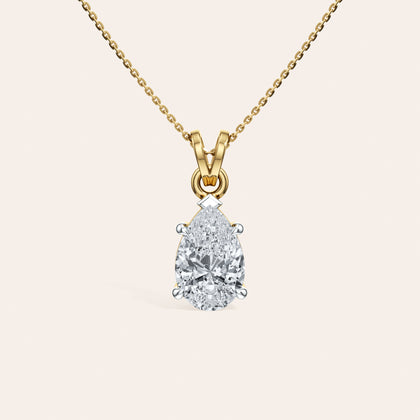
The Lumina Pendant
2.07 CT. T.W.PEAR$2,100.00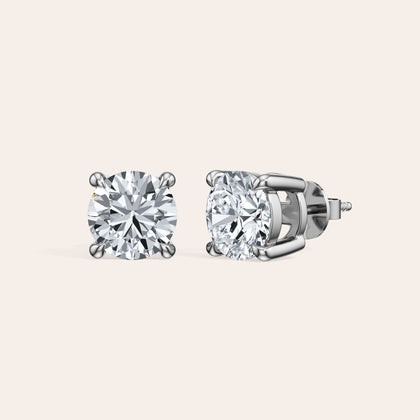
The Lumière Stud 1.5 CT
1.48 CT. T.W.ROUND BRILLIANT$1,080.00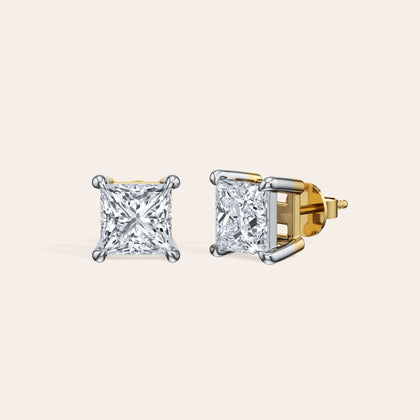
The Crest Stud
1.20 CT. T.W.PRINCESS$1,010.00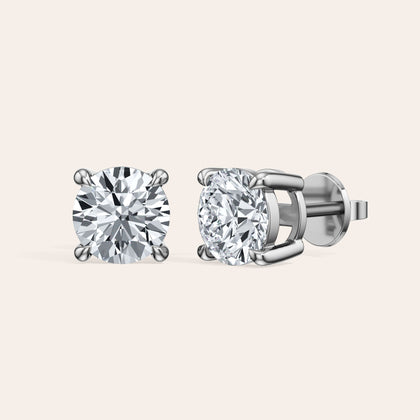
The Lumière Stud 2 CT
2.02 CT. T.W.ROUND BRILLIANT$1,400.00Complimentary shipping and free 14-day returns - decide with total peace of mind, at no cost.