


Diamond Stud Earrings Buying Guide Canada: What to Know Before You Buy

Buying Guide - Canada
Diamond stud earrings are the most-worn piece in a fine jewellery wardrobe. In Canada, the right pair comes down to five decisions: total carat weight, cut, colour and clarity, backing, and whether the 14K gold and IGI certification details are clear before you buy.
1. Stone size for diamond studs
0.5 ct per stone is the everyday classic; 1 ct gives real presence. For most first-time stud buyers, 1.0 ct total weight is the point where the earrings still feel wearable to the office but no longer read as small - it is the size we point undecided customers toward more than any other. Watch the "total" vs "per stone" trap: a listing that says "1 ct TW" means 0.5 ct in each ear, not 1 ct per stone. It is all laid out in the size guide. See current 1 carat diamond stud earrings price in Canada.
2. Cut
This is what makes the ear sparkle. Aim for Excellent: a well-cut stone looks larger and livelier than a big, dull one. Given the choice, we would take a 0.9 ct Excellent-cut stone over a 1.0 ct Very Good - the smaller stone reads brighter across a room, and cut is the one variable you cannot fix after the fact. If you are comparing silhouettes, our diamond shapes guide shows how round, oval, pear, and other cuts read.
3. Colour and clarity
For the current Lumiere solitaire-stud path, diamonds are E-F colour and VVS2 clarity. For other earring styles, always check the colour, clarity, and carat weight stated on the individual product page. Buying online, ask for a photo taken in flat, direct light rather than relying on a listing photo alone - a jeweller's spot lighting flatters every stone, including lower grades.
4. The back
For a pair worn every day, the backing should feel secure and comfortable for the specific piece. For a first pair, we would default to screw backs even under 0.50 ct - the extra half-turn costs nothing, and there is no real upside to a push back beyond very light everyday tops. Push-back vs screw-back.
5. Metal and certificate
14K gold, never plated on an everyday piece. Diamonds over 0.50 carat include their own independent IGI certificate; smaller accent diamonds are certified by IGI at jewellery level. If a listing does not name a specific lab (IGI, GIA, or another recognized grader) and instead just says "certified" or "lab tested," treat that as a red flag, not an oversight.
Diamond studs are not an occasion purchase. They are the jewellery you put on without thinking - so choose them for everyday life.
The checklist, at a glance
| Decision | The right call |
|---|---|
| Stone size | 0.5 ct per stone for everyday, 1 ct for presence. Check "total" vs "per stone". |
| Cut | Excellent above all - it is the sparkle. |
| Colour / clarity | E-F and VVS2 for current Lumiere solitaire studs; check each product page for other styles. |
| Back | Match the backing to the piece and how it will be worn. |
| Metal / certificate | 14K gold, with IGI certification represented according to the jewellery construction. |
When to walk away
Buy with confidence
- A named grading lab on the certificate, with a report number you can look up.
- Colour and clarity stated per stone, not just a total carat weight.
- Solid 14K (or 18K) gold stated explicitly - not "gold-toned" or "gold-filled."
- A real product photo in flat lighting, not a rendered image only.
Walk away
- "Certified" with no lab named anywhere on the page.
- Only a "total weight" figure with no per-stone breakdown on a solitaire pair.
- No mention of gold purity, or vague terms like "gold vermeil" on an everyday piece.
- Studio photos only, with reviews or a return policy that is hard to find.
Our recommendation
For a first pair, start with the per-ear weight, then verify cut, colour, clarity, 14K gold, certification, and backing on the product page. With a budget around $1,000, also compare our under-$1,000 picks.
For the 1 ct size specifically, we published a sourced price comparison across seven Canadian retailers for this exact specification - see the Price Bridge.
What to check before buying diamond studs online
Diamond stud earrings buy very well online, as long as four signals are present: certification appropriate to the piece, real photos, a clear return policy, and tracked Canadian shipping. A return on studs is rarely about the diamond itself - it is usually a backing that does not suit a specific ear, which is exactly what a clear return policy exists to fix. And because studs do not need finger sizing, they are simpler to gift than a ring.
 From the guideThe checklist, worn: 14K gold, IGI certification, visible specifications.The Eden Stud$860.00
View →
From the guideThe checklist, worn: 14K gold, IGI certification, visible specifications.The Eden Stud$860.00
View →
Solitaire, cluster, or hoop: which earring style to choose
If you are still deciding between styles before you even get to size and colour, here is the simplest way to think about it. A solitaire stud puts the entire visual weight on one stone - it is the most timeless choice and the easiest to match with everything. A cluster stud spreads the same carat weight across several smaller stones, giving more visible sparkle for an equivalent budget, usually with a lower, more comfortable profile against the ear. A hoop changes the silhouette entirely and suits someone looking for movement rather than a single fixed point of light. For a first stud purchase, the solitaire remains the safest choice.
Frequently asked
What size for a first pair?
0.5 ct per stone: present, versatile, never too much. The most-worn range.
What quality and certification?
For the current Lumiere solitaire-stud path, diamonds are E-F colour and VVS2 clarity. Diamonds over 0.50 carat include their own independent IGI certificate; smaller accent diamonds are certified at jewellery level.
Which back should I choose?
The right backing depends on the piece and how it will be worn. Always check the backing listed on the product page before comparing two pairs.
Does each stud need its own certificate?
Not always. At Carat Theory, diamonds over 0.50 carat include their own independent IGI certificate. Smaller accent diamonds are certified by IGI at jewellery level.
Solitaire or cluster: which is better for a first pair?
Solitaire, for most people - it is the most timeless style and the easiest to match. Cluster is a good alternative if you want more visible sparkle for the same budget.

You might also like
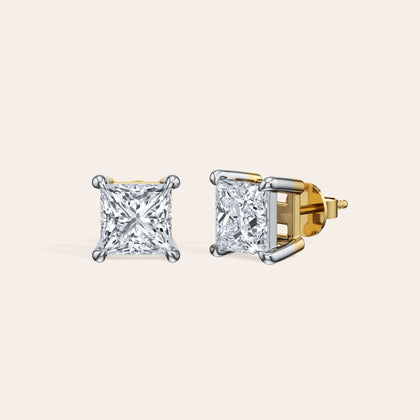
The Crest Stud
1.20 CT. T.W.PRINCESS$1,010.00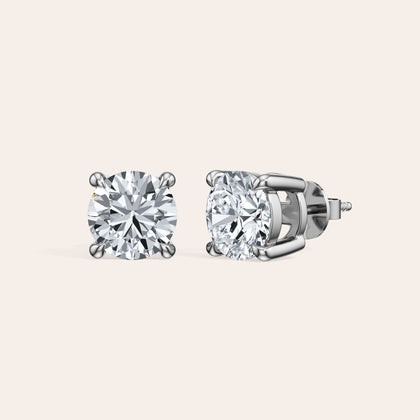
The Lumière Stud 1.5 CT
1.48 CT. T.W.ROUND BRILLIANT$1,080.00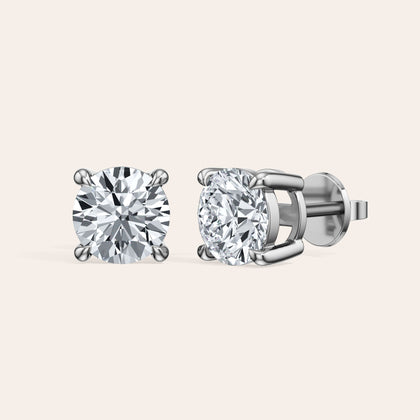
The Lumière Stud 2 CT
2.02 CT. T.W.ROUND BRILLIANT$1,400.00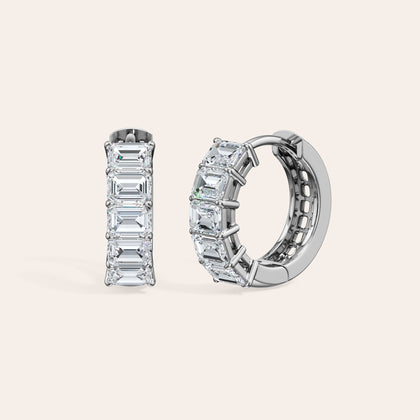
The Prism Hoop
2.28 CT. T.W.EMERALD$1,610.00Complimentary shipping and free 14-day returns - decide with total peace of mind, at no cost.