


How to Wear Diamond Ear Climbers: Position, Fastening and Staying in Place
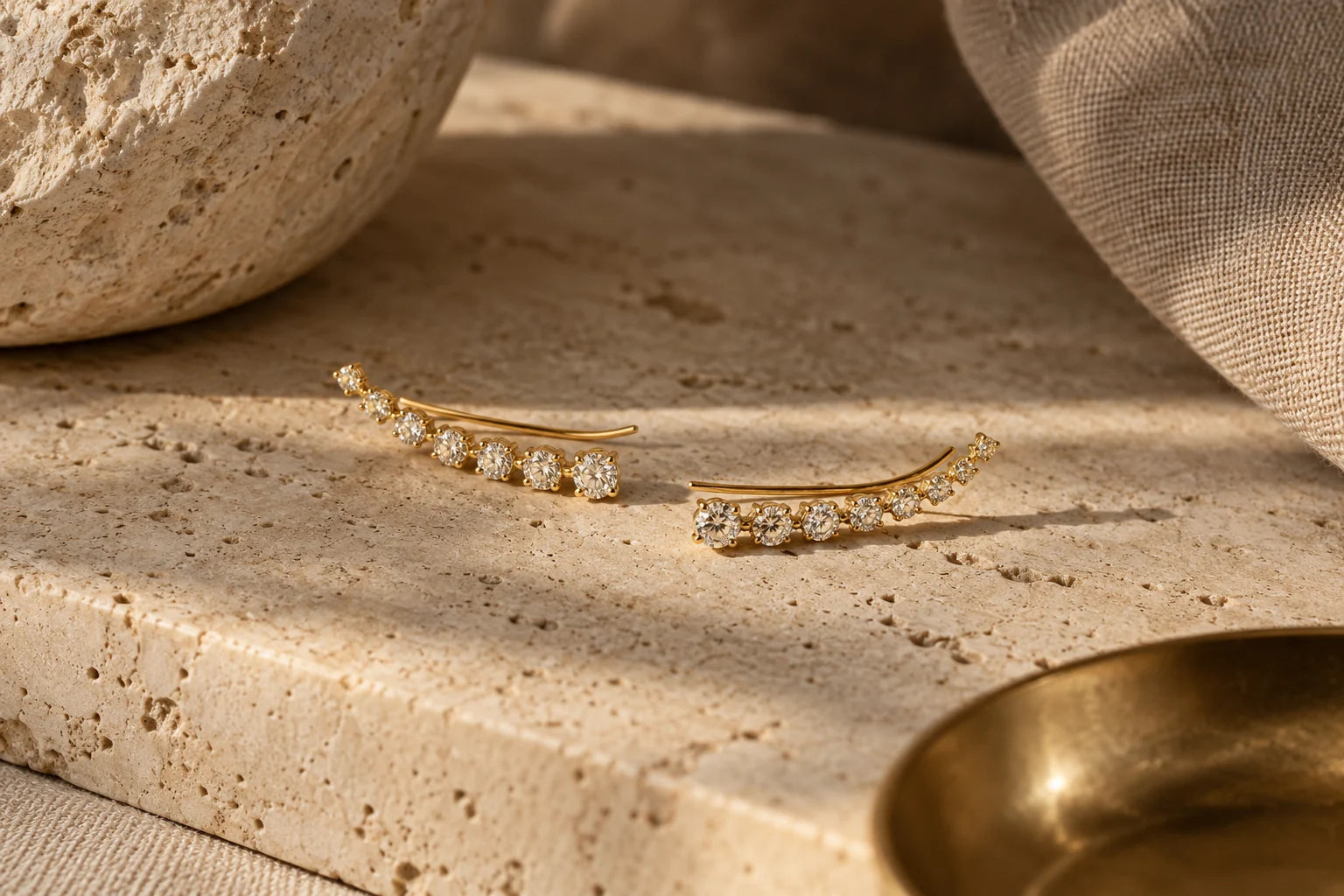
AI-generated editorial illustration. Catalogue images below show the named designs.
An ear climber extends upward along the ear instead of hanging below it. To wear one successfully, understand its backing, use the orientation intended for that piece and check how the curve sits against your ear. The fastening matters as much as the front design.
Climbers, studs and cuffs are different formats
A stud concentrates the decorative design around a post. A climber stretches the design along the ear, often creating the appearance of several elements in a row. A cuff grips part of the ear and may use a different method of attachment. A photograph of the front cannot establish how any one of these pieces is secured.
Some climbers use an elongated rear wire; others use a post and a separate backing or additional support. One seller's insertion or adjustment instructions should not automatically be applied to another design. A useful product view shows the back, the attachment point and the fully worn position.
Summit and Ascension at a glance
The published Carat Theory photographs show elongated curved rear wires on Summit and Ascension. Their catalogue specifications describe the decorative span along the ear. They do not establish the usable gap behind the ear or confirm an adjustment procedure. These prices and specifications were checked on October 6, 2026; prices are CAD before tax.
| Design | CAD before tax | Pair diamond total (CTW) | Published metal | Published dimensions |
|---|---|---|---|---|
| The Summit Climber | $500 | 0.32 | 14K Yellow Gold | 17 mm along the ear, 2 mm wide |
| The Ascension Climber | $1,190 | 0.90 | 14K White Gold | 24.5 mm along the ear, 6 mm wide |


Catalogue images show the named designs. Photographs are not a life-size comparison.
Summit has a 17 mm published span and a 2 mm width, with round diamonds in 14K yellow gold. Ascension has a 24.5 mm span and a 6 mm width, with round and marquise diamonds in 14K white gold.
Ascension is 7.5 mm longer along the ear and 4 mm wider in the published measurements. That tells you about the decorative outline. It does not establish that one design will sit more firmly or feel lighter. Those questions depend on the physical construction and your ear.
Before you put a climber on
- Identify the supplied hardware. Look at the post or wire, backing and any other support. Follow the instructions for the actual piece, rather than treating every climber as a standard stud.
- Check orientation. Some pairs are made for a particular left and right side. Ask the seller to identify any handedness; do not infer it solely from a staged front photograph.
- Understand the fastening sequence. Ask for a demonstration showing insertion, positioning, securing and removal. Confirm the number and location of piercings needed for the exact design.
- Check space around the ear. Note any neighbouring piercings, glasses or accessories that could meet the decorative front or rear wire.
A common positioning sequence and when it applies
For a climber whose maker instructs insertion through a lobe piercing followed by rotation, the sequence is to insert as directed, gently position the decorative line upward and secure the intended backing. The front and back should sit as the maker demonstrates. This is a construction-dependent outline, not a model-specific insertion instruction for every climber.
Do not bend, squeeze or reshape the wire to make a piece fit unless its manufacturer explicitly permits that adjustment and explains how. A wire that looks flexible in a photograph is not proof that the design is intended to be adjusted at home. If the intended position requires force, stop and ask for help with the actual piece.
Why an ear climber may rotate or sit away from the ear
The cause can be orientation, incomplete engagement of the backing, a mismatch between the design curve and the ear, or interaction with another earring. First compare the supplied piece with the maker's worn and rear views. Check whether the fastening is in its proper position before concluding that the front needs reshaping.
If it still rotates, ask the seller to assess the fit. A close photograph of the front and back, showing only what you are comfortable sharing, can be more useful than a general description that it “won't stay on.” Changing the fastening or modifying the metal without guidance can make the problem harder to assess.
Choose the outline you want
Summit's shorter, narrower published line gives you a different visual option from Ascension's longer mixed-shape arrangement. Compare the span against your own ear or an earring you already know. A 24.5 mm product measurement is not a promise about how high the design will reach on every wearer.
For styling, try a climber as the main ear detail before adding other pieces. If you have multiple piercings, check the actual space left around it. Hair can change how much of the line is visible, so compare the style with the way you normally wear your hair. These are preference checks, not fixed rules.
Frequently asked questions
Do ear climbers always need only one piercing?
Many use one lobe piercing, but confirm the requirement for the exact design. The decorative line alone does not identify its support or attachment points.
Will a longer climber stay in place better?
Length does not establish retention. The curve, backing, orientation and individual fit matter. Ask for the actual fastening demonstration.
Are diamond climbers comfortable for everyone?
No product format can establish universal comfort. Check physical weight, dimensions, materials and fit, especially if you already know that a particular backing or alloy does not suit you.
Can I wear a climber beside another stud?
If your piercing arrangement and the actual geometry leave suitable space. Check both fronts and backs rather than judging the combination only from the front.
Explore the climber collection and ask to see how your preferred piece is secured before choosing it. For other shapes within a daily wardrobe, read our everyday earring guide.
Product specifications and published-image reference: October 6, 2026. The exact model-specific fastening procedure requires confirmation on the supplied hardware; this article does not claim a physical wear test.