


Diamond Hoop Size Guide: Outer Diameter, Inner Clearance and How They Sit
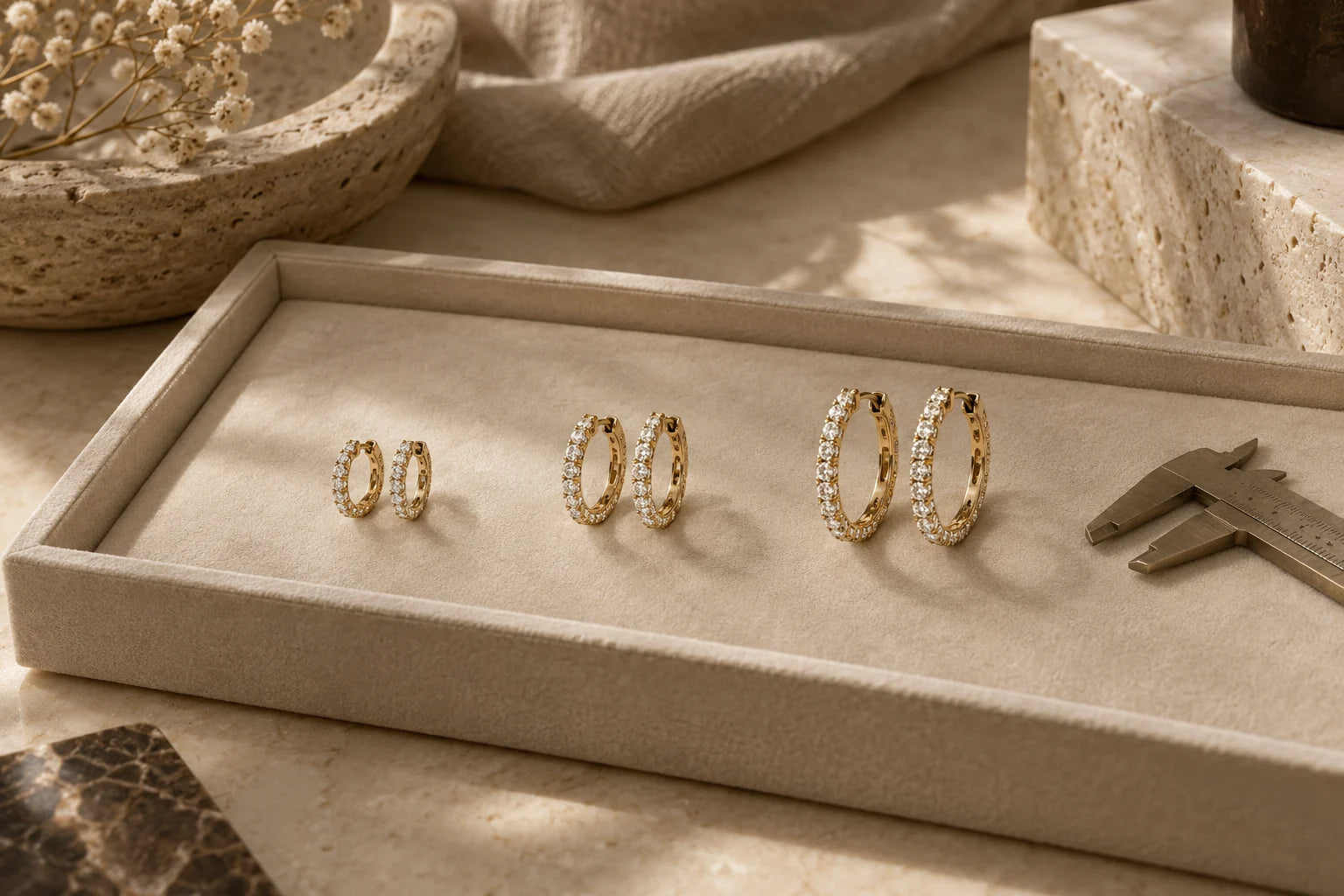
AI-generated editorial illustration. Catalogue images below show the named designs.
Choose a diamond hoop using its outside size, the space available beneath the post and the width of its band. Carat weight answers a different question. A 13.5 mm hoop can be narrow or substantial, and its outside measurement alone cannot tell you whether it will sit close to your particular piercing.
The three measurements worth separating
Outer diameter describes the hoop's external outline. It helps you picture how much of the earring will be visible, especially when you compare it with a pair you already own. If a design is oval, irregular or includes a suspended drop, ask for height and width rather than assuming one diameter describes the entire earring.
Usable inner clearance describes the opening available to your ear beneath the closed post. That is the measurement to discuss when you want a close fit. The hinge, post position, inner curve and thickness of the body can all affect the available space. An outside diameter is not a substitute for a measurement of the actual opening.
Band width and depth describe the body of the hoop. Width helps explain how much metal and diamond pattern you see from the front. Depth helps explain its side profile. Neither number, on its own, establishes physical weight or comfort.
Published Carat Theory hoop dimensions
The following are catalogue measurements, checked on October 6, 2026. They describe outside dimensions and band widths, not a tested fit or measured inner clearance. Prices are CAD before tax.
| Design | CAD before tax | Pair diamond total (CTW) | Published metal | Published dimensions |
|---|---|---|---|---|
| The Frost Hoop | $510 | 0.14 | 14K White Gold | 11 mm outer diameter, 1.25 mm band |
| The Meridian Hoop | $940 | 0.54 | 14K Yellow Gold | 13.5 mm outer diameter, 2 mm band |
| The Prism Hoop | $1,610 | 2.28 | 14K White Gold | 13.5 mm outer diameter, 4 mm band |
| The Grand Hoop | $1,150 | 1.08 | 14K Yellow Gold | 15.5 mm outer diameter, 3.5 mm band |
| The Vogue Hoop | $1,400 | 0.92 | 14K Yellow Gold | 16 mm outer diameter, 6 mm band |
| The Reverie Hoop | $1,580 | 1.36 | 14K Yellow Gold | 18 mm outer diameter, 3 mm band |


Catalogue images show the named designs. Photographs are not a life-size comparison.
Frost has the smallest published outer diameter in this selection at 11 mm. Meridian and Prism both have a 13.5 mm outer diameter, but Meridian has a 2 mm band and Prism a 4 mm band. That pair is a useful reminder that matching diameter does not mean matching visual presence.
Grand increases the published outside diameter to 15.5 mm with a 3.5 mm band. Vogue is 16 mm across outside with a 6 mm band. Reverie is 18 mm outside with a 3 mm band. Look at both columns before deciding which one sounds larger: Vogue has a smaller outside diameter than Reverie but a wider published band.
How to compare a new hoop with one you own
- Start with a pair whose fit you like. Close it as it would be worn and place it beside a millimetre ruler. Record the outside height and width. If you have calipers, avoid pressing against stones or deforming the metal.
- Record the opening beneath the post. Note whether your existing pair has space below your lobe or sits closely. A straight measurement and a curved opening describe different geometry, so keep your reference photograph as well as the number.
- Compare the body of the earring. A broader front can change the look even when the opening is similar. Check a side view for depth and post placement.
- Ask the seller for the same measurements. Give the outside size and inner-opening photograph of your reference pair. This is more useful than asking whether a hoop is “small.”
Your piercing position matters. The distance from the piercing to the bottom of the lobe, the lobe's thickness and the earring's post geometry help determine whether a close-fitting hoop is suitable. Two people can wear the same outer diameter with different amounts of space below the ear.
Huggies versus hoops
“Huggie” describes a close-fitting style rather than one universal millimetre size. A hoop called a huggie by one seller may fit another person's ear with a visible gap. For an online purchase, use the dimensions and the actual closure view to make the decision.
If you want the hoop to sit close to the lobe, make inner clearance the first question. If you want a visible circular outline below the ear, compare outside size as well. Choose the space your ear needs before choosing how much diamond weight you want.
When a drop-hoop needs another measurement
Cascade, Lattice and Opulence add a drop to the hoop format. Their overall drop lengths should not be compared directly with the outer diameter of a plain circular hoop. For example, Cascade's published 16 mm drop is not a claim that its hoop body has a 16 mm diameter.
Ask for the hoop-body dimensions, usable opening and the total hanging length. The total helps you picture how far the piece extends; the opening helps you assess the part that goes around your ear. Our hoop price guide keeps each design's published measurement description beside its price.
Fastening and wearing checks
A front photograph cannot show you how a closure works. Ask for a rear or side view and an opening-and-closing demonstration of the exact style. Before wearing a new pair, understand how the post engages and what the properly closed position looks like. A click alone is not evidence of a secure or comfortable fit.
Consider how the earring will sit beside other piercings, hair, collars and anything you wear around the ear. These are individual checks, not reasons to assign a universal “best everyday size” to one diameter.
Frequently asked questions
Does a wider band mean the hoop will have less space inside?
You cannot calculate usable clearance from published diameter and band width alone. The visible width may describe a different direction from the metal's thickness. Ask for the opening measured beneath the closed post.
Does more carat weight mean a larger hoop?
Not necessarily. Prism and Meridian have the same published outer diameter while carrying different diamond totals and band widths. Compare the whole design.
Can I use a product photograph as a life-size guide?
Only when the photograph provides a reliable scale. A close-up fills the frame regardless of the earring's size. A ruler, measured drawing or dimensions alongside the image makes the comparison more useful.
Explore the hoop collection, choose the outline you like and ask for the fit measurements that matter for your ear.
Catalogue reference: October 6, 2026. External dimensions are published specifications; inner clearance and physical fit are not established by this article.