


Diamond Clarity, Colour & Quality Beyond the 4Cs

Beyond the 4Cs
Everyone learns the 4Cs - cut, colour, clarity, carat. But two diamonds with the same four grades can look very different by eye. What separates a beautiful diamond from a merely fine one mostly lives in what the spec sheet doesn't say.
Let's take the 4Cs in one line first, then what they leave out.
The 4Cs, in one sentence
Cut: the quality of the cutting, which creates sparkle. Colour: from colourless (D) toward warm. Clarity: the presence of inclusions. Carat: the weight. Useful - but they are grades on paper, not a guarantee of beauty.
What the 4Cs don't tell you
What really matters
- Light performance: how the stone actually returns light in motion.
- Proportions and symmetry: a poorly proportioned "Excellent" cut exists.
- "Eye-clean": clarity you can't see is enough.
- How it behaves in real light, not under the shop lamp.
What people overpay for
- The very last shade of colour (D) when D-F is already superb.
- FL-IF clarity when VVS is already well past visible.
- An extra quarter-carat, invisible but expensive.
Proportions, in actual numbers
For a round brilliant, proportions are what bring the light to life. Two reference points serve the informed eye: a table around 54-58% and a depth around 59-62.5%. Stray far beyond, and light leaks out the side or bottom, and the stone goes flat - even with lovely colour and clarity. This is exactly what two diamonds "with the same 4Cs" may not share.
Cut is king. A superbly cut stone will always beat a "perfect" stone that was cut poorly.
Fluorescence, the quiet fifth factor
Rarely mentioned, fluorescence is the bluish glow some diamonds give under UV light. Faint to medium, it is usually invisible and can even make a slightly warm colour read a touch whiter - occasionally a bargain. Very strong, in rare cases, it can lend a milky haze. Worth checking on the certificate, without making it an obsession.
Fancy shapes and the "bow-tie"
On elongated shapes - oval, marquise, pear - watch for the bow-tie: a dark, bow-shaped shadow across the centre, a sign of imperfect cutting. No grade flags it; only the eye (or a good video) reveals it. A well-cut elongated stone shows almost none.
How to judge without a loupe
Look at the stone in motion, in natural light. 360 videos and light-performance tools help, but your eye is still the best judge: a beautiful stone is lively, full of contrast, never flat or milky.
Where we stop on the scale, and why
Our stones are E-F colour and VVS-VS clarity. That is not the top of the scale, and the choice is deliberate. VVS already means inclusions are hard to find under 10x magnification; above that you are paying for wording on a report rather than a visible difference. Colour works the same way: once set and viewed face-up, an E-F stone does not read differently from a D. What we save above that threshold goes into the stone itself, into the setting work, or into the price. It is a trade, not a compromise on quality.
The simple rule
Put your budget into cut first - it creates the sparkle. Colour and clarity matter, but past a point the eye stops seeing the difference. This is even truer for lab-grown: the large majority already cluster at the high end of the colour and clarity scales, so the real playing field is the cut. At Carat Theory, that level is built in: every diamond 0.5 ct and up is D-F colour, VVS clarity, with its own IGI certificate. So you never trade away quality - you simply choose cut, shape, and setting.
 Cut firstE-F colour and VVS2 clarity built in, so the choice is the light.The Tableau Stud$970.00
View →
Cut firstE-F colour and VVS2 clarity built in, so the choice is the light.The Tableau Stud$970.00
View →
Frequently asked
So the 4Cs aren't enough?
They are a good starting point, but they don't capture light performance or proportions - which is what actually makes a stone come alive.
Which grade should I prioritise?
Cut, without hesitation. It is what turns light into sparkle.
Is fluorescence a problem?
Rarely. Faint to medium is invisible and sometimes an advantage. Only very strong fluorescence deserves a careful look.
How do I judge without being an expert?
Look at the stone in motion, in natural light. If it is lively and bright to the naked eye, the numbers matter less.

You might also like
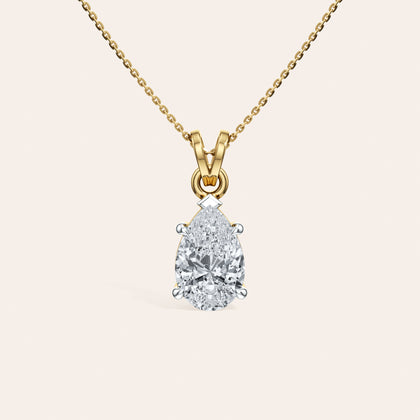
The Lumina Pendant
2.07 CT. T.W.PEAR$2,100.00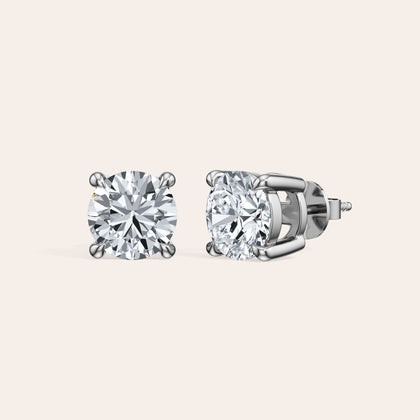
The Lumière Stud 1.5 CT
1.48 CT. T.W.ROUND BRILLIANT$1,080.00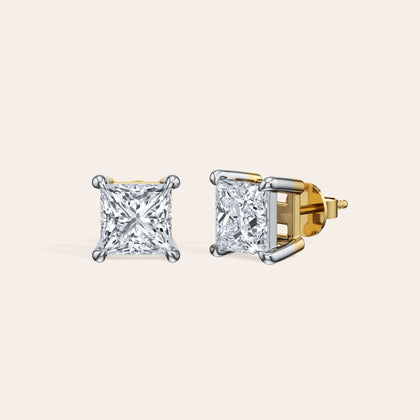
The Crest Stud
1.20 CT. T.W.PRINCESS$1,010.00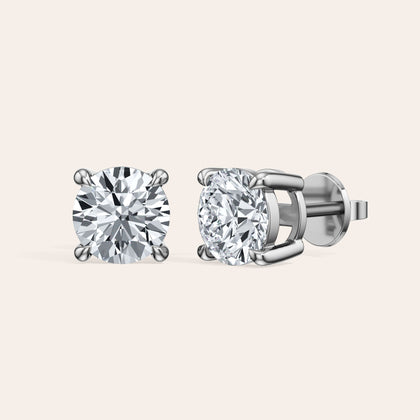
The Lumière Stud 2 CT
2.02 CT. T.W.ROUND BRILLIANT$1,400.00Complimentary shipping and free 14-day returns - decide with total peace of mind, at no cost.