


How Should a Tennis Bracelet Fit? A Practical Sizing Guide

The fit
A tennis bracelet is worn every day, often without a thought. That is exactly why fit matters more than anything: too tight and it nags; too loose and it eventually goes missing.
The right rule, simply
A tennis bracelet should slide and turn freely around the wrist, but not slip over the hand. In practice: you should be able to fit one finger between the bracelet and your wrist, no more. That is the line between comfort and security.
How to measure your wrist
Wrap a tape measure around your wrist, just below the bone, where you would wear the bracelet - ideally at the end of the day, when your wrist is at its largest. To turn that measurement into an exact length, follow our bracelet size guide, which gives the precise sizing.
The comfort rule stays simple: you should be able to slide one finger between the bracelet and your wrist. If you are between two lengths, take the larger - a link can be removed, but adding one is not easy.
The most beautiful bracelet in the world is useless if it slides off your wrist into a coat pocket.
Standard lengths, as reference points
Most women's tennis bracelets run between 6.5 and 7.5 inches (16.5 to 19 cm). Here are the most common matches.
| Wrist circumference | Suggested length | Reads as |
|---|---|---|
| 14 - 15 cm | 6.5 in (16.5 cm) | Fitted, delicate |
| 15 - 16.5 cm | 7 in (17.8 cm) | The most common, balanced |
| 16.5 - 18 cm | 7.25 - 7.5 in (18.4 - 19 cm) | Fluid, free movement |
Flexible or semi-rigid
Two constructions exist. The flexible, link-by-link build follows the wrist and moves with you - the most common and most comfortable for daily wear. The semi-rigid build holds its shape more and rides up the hand less, useful for slim wrists. When trying one on, watch how it falls: it should follow the wrist, not stay stiff.
The clasp - the detail that saves a bracelet
Because it is worn continuously, a tennis bracelet lives or dies by its clasp. Look for a box clasp with a safety catch (a small figure-eight or a tab that folds over). It is what prevents loss if the main clasp pops open by accident. Less glamorous than the diamonds, but it is what keeps the bracelet on your wrist ten years from now.
 Choose the right fitFive lengths from 6 to 7 inches in quarter-inch steps.The Legacy Tennis Bracelet$2,160.00
View →
Choose the right fitFive lengths from 6 to 7 inches in quarter-inch steps.The Legacy Tennis Bracelet$2,160.00
View →
Frequently asked
Should it be tight or loose?
In between: free to turn, but unable to slip over the hand. About one finger of room.
Can the length be adjusted after buying?
Yes, usually by removing links. That is why it is better to size slightly large than too small.
Can I sleep and shower in it?
It will survive, but to protect the sparkle and the clasp, take it off for sport, showers, and sleep when you remember.
Read next: Bracelet size guide · Full buying guide

You might also like
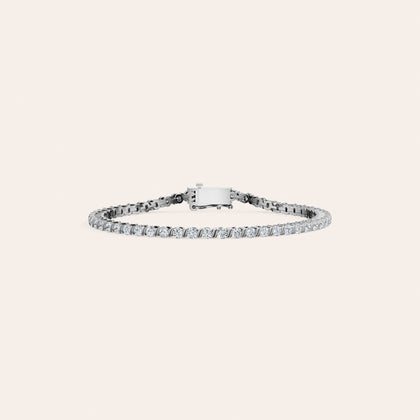
The Legacy Tennis Bracelet
2.39 CT. T.W.ROUND BRILLIANT$2,160.00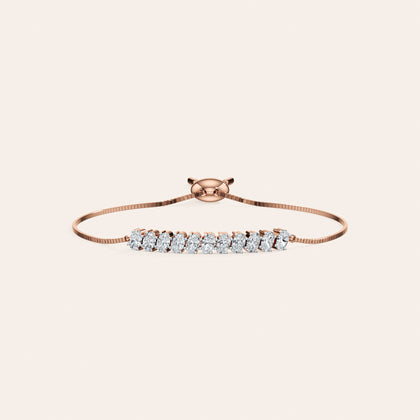
The Rosé Station Bracelet
2.25 CT. T.W.OVAL$2,050.00Complimentary shipping and free 14-day returns - decide with total peace of mind, at no cost.